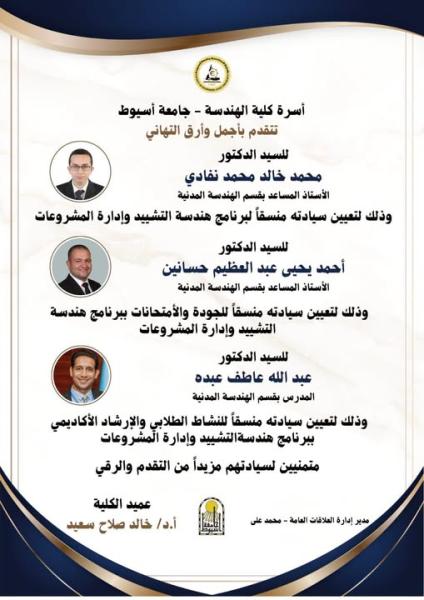
Congratulations from the Dean of the College

On behalf of the Faculty administration and all its staff, Professor Dr. Khaled Salah, Dean of the Faculty, extends his sincere congratulations to Dr. Ahmed Mohamed Attia Abdel-Qader—Assistant Professor in the Department of Mechanical Design and Production Engineering—on his appointment by the University President, Professor Dr. Ahmed Abdel-Mawla, as Deputy Director of the International Academic Ranking Office at Assiut University.

We wish him continued success and prosperity as he serves the University and the academic community.1

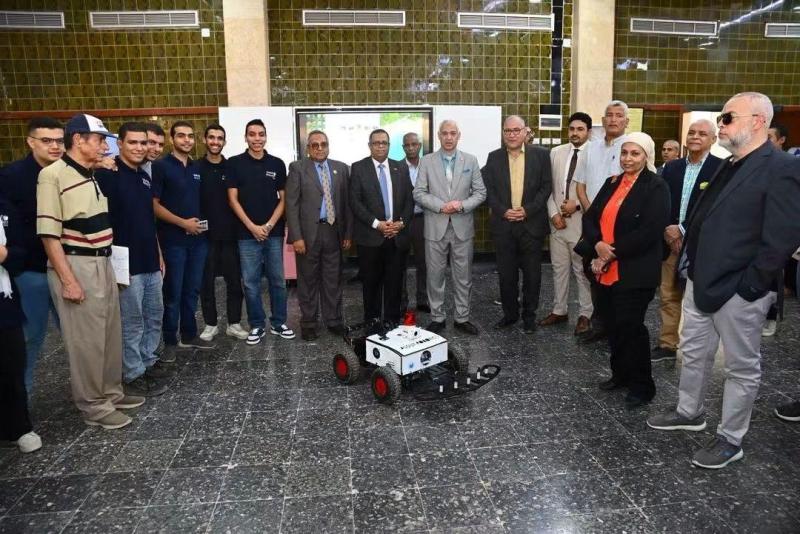
The "Assiut Robotics" team from the Faculty of Engineering wins the Best Mechanical Design award at the international landmine-clearing competition.

The "Assiut Robotics" team from the Faculty of Engineering has won the "Best Mechanical Design" award at the international "Minesweepers: Towards a Landmine-Free World" competition.

Under the patronage of Prof. Ahmed Abdel-Mawla, President of Assiut University, and Prof. Khaled Salah Saeed, Dean of the Faculty of Engineering—and under the supervision of Prof. Mazen Abdel-Salam from the Department of Electrical Engineering—the "Assiut Robotics" team from the Faculty of Engineering at Assiut University has added a new engineering achievement to its impressive track record. This success came during their participation in the 2026 edition of the international "Minesweepers: Towards a Landmine-Free World" competition, held on October 17, 2026, at Zewail City of Science and Technology.

The team was awarded the prize for "Best Mechanical Design," outperforming all other participating teams in terms of engineering and design. The competition is one of the most prominent international engineering forums dedicated to the development of robots for landmine detection and removal.

The robot was specifically designed and built to navigate rugged terrain, detect both surface and buried landmines, map their locations, and subsequently retrieve them, all through an integrated engineering system.

The participating students include: Ahmed Eid El-Madi (Team Leader), Hagar Mahmoud Mohamed El-Amir (Project Leader), Ahmed Nady Mohamed, Anthony Gais Akhnoukh, Safi El-Din Mohamed, Mostafa Mohamed, Haneen Montaser Soliman, Diaa Hassan Saad, Amina Hassan Mahmoud, Ahmed Orabi Mohamed, Ibrahim Sayed Ali, Rahma Essam Nabawy, and Abdelrahman Alaa Ali. The Dean of the Faculty extended his congratulations to the team, as well as to the supervisory and support team, which includes Professor Mazen Abdel-Salam, Dr. Mohamed Eid Abdel-Mawla, Engineer Ibrahim Mohamed Sayed, Engineer Sayed Khader Khalaf, Engineer Islam Wael, Mr. Mohamed Sharaqa (Director of the Student Welfare Department), and Mr. Mohamed Ahmed Sayed (Supervisor of the Scientific Committee).

1
1
1
1
1
2
2
1

Improving dynamic parameter estimation in electric vehicle batteries: A comparative study of FFRLS methods with Open Circuit Voltage assumptions

Research Abstract

Accurate battery modelling is crucial for Battery Management Systems (BMS) to ensure precise state estimation and dynamic characteristic prediction, optimizing power and energy management in Electric Vehicles (EVs). Among various models, the Electric Equivalent Circuit Model (EECM) is widely used due to its ability to represent dynamic battery behaviour. However, its accuracy in EV applications is impacted by time-varying parameters such as temperature, current, State of Charge (SoC), and State of Health (SoH). This study addresses the limitations of conventional RLS algorithms by proposing a systematic evaluation of seven Forgetting Factor Recursive Least Squares (FFRLS) methods under dynamic conditions. Two Open Circuit Voltage (OCV) assumptions-OCV as an estimated parameter and as a function of SoC-are considered. Using a second-order Thevenin model in MATLAB/Simulink and …

Research Authors
Mohamed AA Mohamed, Joseph Du Gard, Tung Fai Yu, Thomas Grandjean
Research Date
Research Department
Research Journal
Journal of Energy Storage
Research Website
https://www.sciencedirect.com/science/article/pii/S2352152X2500876X
Research Year
2025

Advancements in parameter estimation techniques for 1RC and 2RC equivalent circuit models of lithium-ion batteries: A comprehensive review

Research Abstract

The growing reliance on batteries across diverse applications highlights their essential role in everyday life. In an increasingly electrical world, it is crucial that Lithium-ion Batteries (LIBs), known for their high energy density and extended cycle life, can be understood and utilised for optimal performance. Having a Battery Management System (BMS) that can provide accurate state determination is therefore essential. Among the various models discussed in the literature, the focus often narrows down to 1RC and 2RC Electric Equivalent Circuit Models (EECMs), due to their widespread use and capability to accurately represent the nonlinear behaviour of batteries. This provides a balance between high estimation accuracy and manageable computational complexity, making them suitable for real-time applications, while aligning with the practical requirements of online battery management systems. With three to six …

Research Authors
Mohamed AA Mohamed, Tung Fai Yu, Grace Ramsden, James Marco, Thomas Grandjean
Research Date
Research Department
Research Journal
Journal of Energy Storage
Research Website
https://www.sciencedirect.com/science/article/pii/S2352152X25002944
Research Year
2025

Effect of canal bed slope on the working efficiency of water energy dissipaters downstream control structures

Research Authors
Mohamed A. Ashour; Tarek S. Abu-zaid; Mahmoud A. Sayed; Abdallah A. Abdou
Research Date
Research Department
Research File
Research Journal
Journal of King Saud University – Engineering Sciences
Research Pages
17
Research Publisher
springer
Research Rank
Q1
Research Vol
38
Research Website
https://doi.org/10.1007/s44444-025-00084-w
Research Year
2026

The *Journal of Engineering Sciences*, published by the Faculty of Engineering, has advanced to the fourth position in the Arab world within the field of engineering and technological sciences (Q1), according to the 2026 "ARCIF" report.

The *Journal of Engineering Sciences*, published by the Faculty of Engineering, has advanced to the fourth position in the Arab world within the field of engineering and technological sciences (Q1), according to the 2026 "ARCIF" report.

Under the patronage of Prof. Ahmed Abdel-Mawla, President of the University, and Prof. Gamal Badr, Vice President for Postgraduate Studies and Research, and under the supervision of Prof. Khaled Salah, Dean of the Faculty, and Prof. Shehata El-Dabaa Abdel-Rahim, Vice Dean for Postgraduate Studies and Research, the *Journal of Engineering Sciences* has achieved a significant milestone in the Arab ranking of scientific journals. The "ARCIF" (Arab Citation & Impact Factor) initiative—part of the "Marefa" database—announced that the *Journal of Engineering Sciences*, issued by the Faculty of Engineering at Assiut University, has met international accreditation standards, earning a "Q1" (first-tier) ranking in its 11th annual report for 2026.

The ARCIF initiative reported that it evaluated over 5,650 scientific and research journals across various disciplines, published by more than 2,600 academic and research institutions throughout the Arab world. Only 1,303 of these journals met the initiative’s established international criteria—a group that includes the *Journal of Engineering Sciences* from the Faculty of Engineering at Assiut University, which successfully fulfilled all 32 required accreditation standards.

The journal’s general ARCIF impact factor for 2026 reached 0.0909. By securing a Q1 (first-quartile) ranking among 17 journals in the field of Engineering and Technological Sciences (interdisciplinary) within the Arab region, the journal has positioned itself among the top four Arab journals in this discipline—a field that maintains an average "ARCIF" impact factor of 0.216.

The ARCIF (Arab Citation & Impact Factor) system indicates that a journal’s classification into specific quartiles is determined by the total score it achieves across five established criteria, which can be reviewed on the initiative’s official website.

This achievement was communicated in an official letter addressed to the journal’s editor-in-chief, signed by Prof. Sami Al-Khazendar, head of the ARCIF impact factor initiative.

In this context, Prof. Khaled Salah, Dean of the Faculty, extends his congratulations to the university administration—led by University President Prof. Ahmed Abdel-Moula and Vice President for Postgraduate Studies and Research Prof. Gamal Badr—on this significant milestone. He also expresses his congratulations, gratitude, and appreciation to Prof. Shehata El-Dabaa Abdel-Rahim, Vice Dean for Postgraduate Studies and Research and supervisor of the journal, as well as to the entire editorial board for this outstanding accomplishment, wishing them continued success.

It is worth noting that the journal has climbed in the rankings compared to the previous year, moving from the (5–8) range to the fourth position this year out of 17 registered journals across the Arab world. Furthermore, it has advanced from the Q2 to the Q1 category within the Arab-region classification.

The classification criteria can be viewed at the following link: e-marefa.net/arcif/criteria

Journal Link:

https://jesaun.journals.ekb.eg

The Dean of the College announces the reconstitution of the Board of Directors for the Scientific Equipment Maintenance Center.

The Dean of the Faculty Announces the Reconstitution of the Board of Directors for the Scientific Equipment Maintenance Center.

Professor Khaled Salah, Dean of the Faculty, announced that Professor Ahmed Abdel-Mawla, President of Assiut University, has issued Decree No. (4703) dated October 6, 2026, regarding the reconstitution of the Board of Directors for the University’s Scientific Equipment Maintenance Center for a three-year term.

This decision is made in accordance with the Center’s bylaws, and follows a review of the Universities Organization Law No. (49) of 1972, the Civil Service Law No. (81) of 2016, and their respective executive regulations. The decree is based on the University Council’s approval of the Center’s financial and administrative regulations, as well as the University Council’s decision No. (777) dated May 19, 2026—which approved an amendment to Article (3) of the regulations concerning the composition of the Board—and the subsequent approval of this amendment by the Ministry of Finance.

In its new composition, the Board is chaired by the Dean of the Faculty of Engineering and includes the following members:

- The Vice Deans for Postgraduate Studies and Research from the Faculties of Science, Medicine, Pharmacy, Veterinary Medicine, Agriculture, and Engineering.

- The Heads of the Electrical Engineering and Mechanical Engineering Departments at the Faculty of Engineering.

- The Director of the University’s Surplus/Disposal Center (Center for Equipment Decommissioning).

- Dr. Hammad Abu Zaid Mohamed Ahmed, a lecturer in the Department of Electrical Engineering and the supervisor of the Center.

- The Secretary-General of the University.

- Engineer Mamdouh Mohamed Abdel-Moati, serving as the Director of the Center.

The decree aims to enhance the Center’s efficiency and strengthen its role in supporting the University’s research and educational activities by incorporating into the Board of Directors representatives (Vice Deans) from the faculties that most frequently require the Center’s services. In this regard, Professor Dr. Khaled Salah, Dean of the Faculty, extends his congratulations to the new faculty vice-deans appointed following the recent amendment. He also expresses his gratitude and appreciation to the university administration—led by the University President, Professor Dr. Ahmed Abdel-Mawla—for issuing this decision.

 
1
1
 
1
 
1

The Dean of the Faculty announces a change in the composition of the Workshops Unit Board at the Faculty of Engineering.

The Dean of the Faculty of Engineering Announces a Restructuring of the Workshops Unit’s Board of Directors.

Professor Khaled Salah, Dean of the Faculty of Engineering, has announced the issuance of a decree by Professor Ahmed Abdel-Mawla, President of Assiut University—Decree No. (4704) dated October 6, 2026—which restructures the Board of Directors of the Workshops Unit at the Faculty of Engineering for a two-year term.

This decision is made in accordance with the unit’s financial and administrative regulations, and in light of the Universities Organization Law No. (49) of 1972, its executive regulations, and subsequent amendments. The decree is based on the University Council’s approval of the unit’s financial regulations—following their review and endorsement by the Ministry of Finance—as well as the University Council’s successive resolutions to amend Article (3), which governs the composition of the Board of Directors. Furthermore, it follows the University Council’s approval (Resolution No. 774, dated February 24, 2026) to amend Article (3) of the regulations, a change that has also received the approval of the Ministry of Finance.

In its new composition, the Board is chaired by the Dean of the Faculty, with the Head of the Mechanical Design and Production Engineering Department serving as Vice-Chair. The Board also includes the following members:

- The Vice Dean for Community Service and Environmental Development.

- The Head of the Architecture Department.

- The Head of the Electrical Engineering Department.

- Professor Shimi Mohamed Ahmed, Emeritus Professor in the Department of Mechanical Design and Production Engineering.

- Dr. Ahmed Abdel-Alim Amin, Lecturer in the Department of Mechanical Design and Production Engineering.

- Dr. Mahmoud Mohamed Atef, General Supervisor of the Workshops Unit.

- The Secretary of the Faculty of Engineering. - Engineer Mohamed Abdel Moneim Mahmoud Ibrahim, Head of the Engineering Sector at the Asyut Fertilizer Plants.

- Mr. Mohamed Mousa Mohamed, Administrative Manager of the Workshops.

The decision aims to enhance the efficiency of the workshops unit and strengthen its role in supporting educational, research, and community-oriented activities within the faculty, the university, and society at large.

In this regard, Professor Khaled Salah, Dean of the Faculty, extends his congratulations to the members of the council in its newly appointed composition. He also expresses his gratitude and appreciation to the university administration—led by Professor Ahmed Abdel Mawla, President of the University—for issuing this decision.

1
1
1
1
1
Subscribe to