

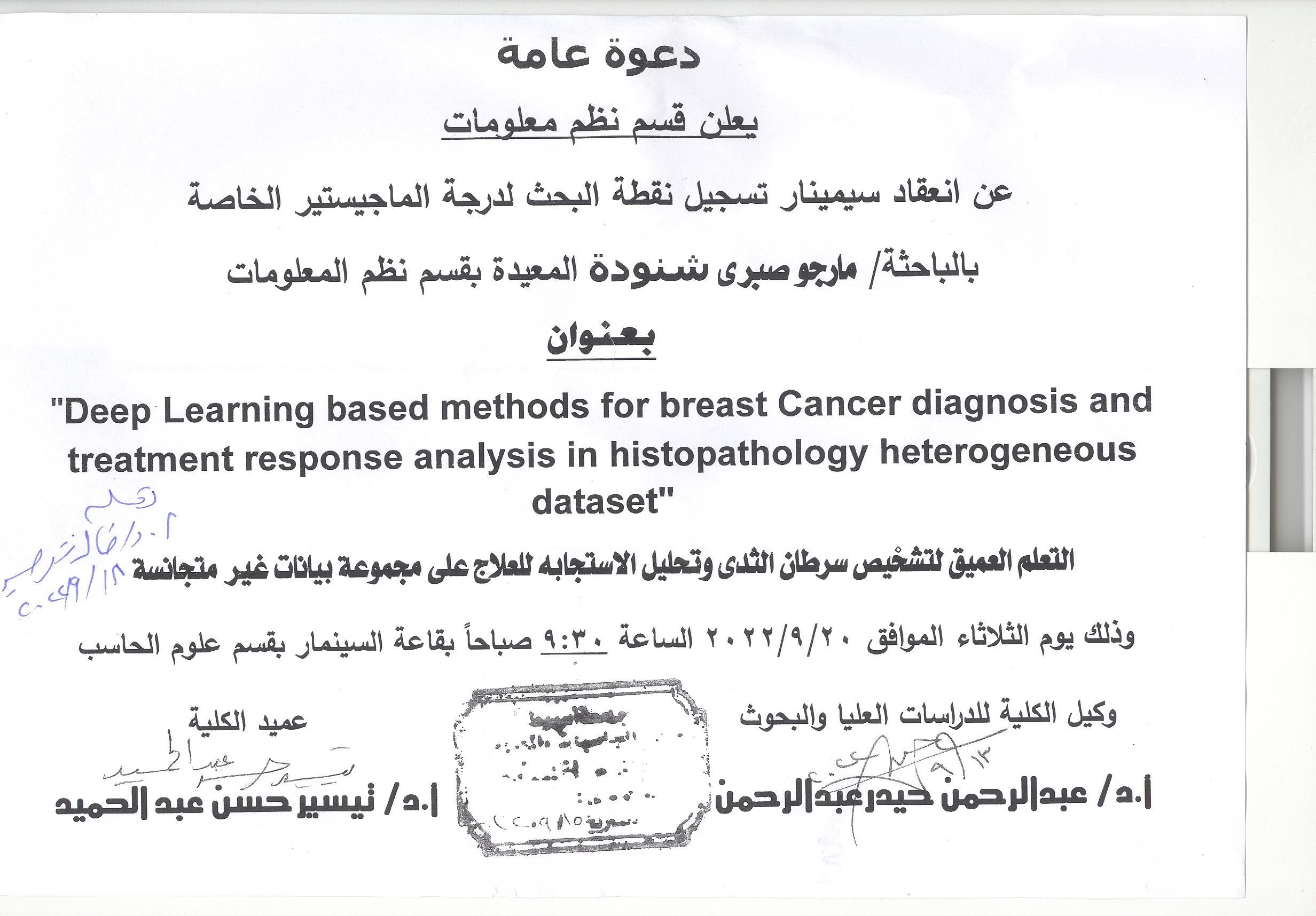
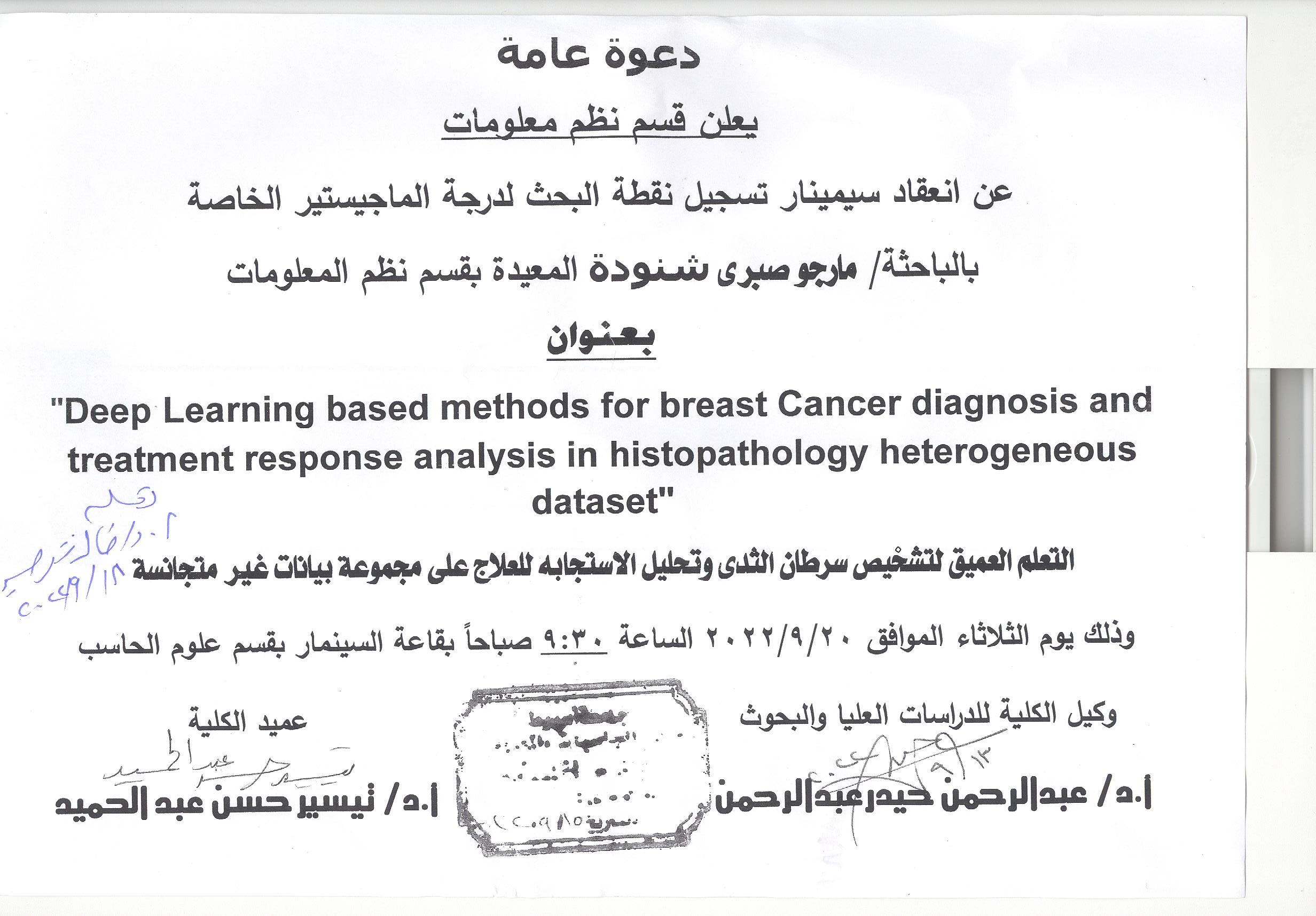
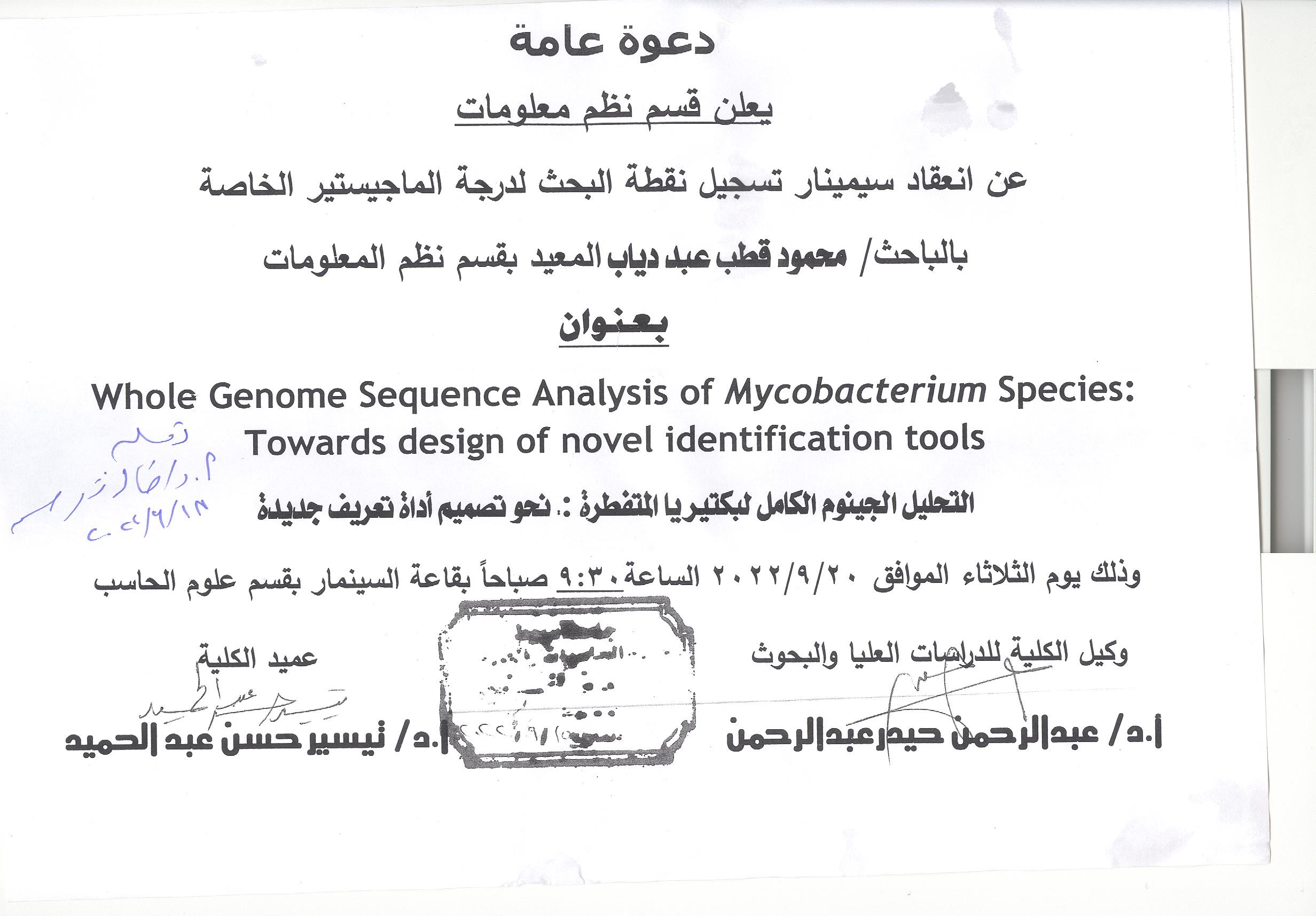

Invite you to attend a seminar to register a research point for the master's degree for the researcher / Mahmoud Qutb Al-Demonstrator at the Department of Information Systems
Meeting with students and parents in the presence of Mrs. Prof. Dr. / Dean of the Faculty and Mr. Prof. Dr. / Vice Dean for Education and Student Affairs

اعــــــــــلان هـــــــــــام
سيتم عمل لقاء مع الطلاب واولياء الأمور بحضور السيدة الاستاذ الدكتور /عميد الكلية والسيد الاستاذ الدكتور/ وكيل الكلية لشئون التعليم والطلاب للتعريف بالبرامج الخاصة وذلك يوم الأربعاء الموافق 21/9/2022 بمدرج 2 بالكلية من الساعة الثانية عشر ظهراَ0
Discuss graduation projects for summer semester students
اعــــــــــلان هـــــــــــام
لمناقشة مشاريع التخرج الفصل الصيفي 2021 /2022
سيتم مناقشة مشاريع التخرج لطلاب الفصل الدراسي الصيفي للعام الجامعي 2021/2022 م يوم الاحد الموافق 25/9/2022 م 0
Invite you to attend the discussion of the master's thesis of the researcher / Badriya Dahi

Kohtd: Kazakh offline handwritten text dataset
Research Abstract
Despite the transition to digital information exchange, many documents, such as invoices, taxes, memos and questionnaires, historical data, and answers to exam questions, still require handwritten inputs. In this regard, there is a need to implement Handwritten Text Recognition (HTR) which is an automatic way to decrypt records using a computer. Handwriting recognition is challenging because of the virtually infinite number of ways a person can write the same message. For this proposal we introduce Kazakh handwritten text recognition research, a comprehensive dataset of Kazakh handwritten texts is necessary. This is particularly true given the lack of a dataset for handwritten Kazakh text. In this paper, we proposed our extensive Kazakh offline Handwritten Text dataset (KOHTD), which has 3000 handwritten exam papers and more than 140335 segmented images and there are approximately 922010 symbols
Research Date
Research Department
Research Journal
Signal Processing: Image Communication
Research Member
Research Year
2022
D-ARP: An Efficient Scheme to Detect and Prevent ARP Spoofing
Research Abstract
Nowadays, cyber-attack is a severe criminal violation, and it is one of the most active fields of research. A Man-in-the-middle attack (MITM) is a type of cyber-attack in which an unauthorized third party secretly accesses the communication between two hosts in the same network to read/modify the transferred data between them. ARP spoofing-based MITM attack exploits ARP protocol weakness where the attacker associates its MAC address with the IP address of an intended legitimate host. Although there are many defense approaches for ARP spoofing based-MITM attacks, these methods are uncompleted or have a performance overhead since they modify the original ARP protocol. Also, some of these approaches depend on the centralized server, which is a single point of failure. This paper presents a detection scheme for ARP spoofing-based MITM attack called D-ARP, which is compatible with the original ARP protocol. The main idea of D-ARP is to send an ARP packet signed with a key in parallel with the original ARP packets to make a correlation between requests and replies. Each host records all types of signing ARP packets in a log file. Based on this correlation, D-ARP matches the injected key to detect ARP spoofing if there is a duplicate or conflict in the MAC address. For more reliability, D-ARP uses the DHCP server and the Nmap feature to detect the MAC addresses of MITM attackers. Moreover, this scheme also offers a module for Admin to create a trusted list of hosts. The experimental results show that D-ARP is highly effective for detecting and preventing ARP spoofing with zero false positives and zero false negative probabilities.
Research Date
Research Department
Research Member
Automated Question Answer medical model based on Deep Learning Technology
Research Abstract
Artificial intelligence can now provide more solutions for different problems, especially in the medical field. One of those problems is the lack of answers to any given medical/health-related question. The Internet is full of forums that allow people to ask some specific questions and get great answers for them. Nevertheless, browsing these questions to locate a similar case to your own question, also finding a satisfying accurate answer is difficult and timeconsuming task. This research will introduce a solution to these problems by automating the process of generating qualified answers to these questions and creating a kind of digital doctor. Furthermore, this research will train an end-to-end model using the framework of RNN and the encoder decoder to generate sensible and useful answers to a small set of medical/health issues. The proposed model was trained and evaluated using data from various online services …
Research Date
Research Department
Research Journal
ICEMIS'20: Proceedings of the 6th International Conference on Engineering & MIS 2020
Research Member
Classification of Handwritten Names of Cities and Handwritten Text Recognition using Various Deep Learning Models
Research Abstract
This article discusses the problem of handwriting recognition in Kazakh and Russian languages. This area is poorly studied since in the literature there are almost no works in this direction. We have tried to describe various approaches and achievements of recent years in the development of handwritten recognition models in relation to Cyrillic graphics. The first model uses deep convolutional neural networks (CNNs) for feature extraction and a fully connected multilayer perceptron neural network (MLP) for word classification. The second model, called SimpleHTR, uses CNN and recurrent neural network (RNN) layers to extract information from images. We also proposed the Bluechet and Puchserver models to compare the results. Due to the lack of available open datasets in Russian and Kazakh languages, we carried out work to collect data that included handwritten names of countries and cities from 42 different Cyrillic words, written more than 500 times in different handwriting. We also used a handwritten database of Kazakh and Russian languages (HKR). This is a new database of Cyrillic words (not only countries and cities) for the Russian and Kazakh languages, created by the authors of this work.
Research Date
Research Department
Research Journal
Advances in Science, Technology and Engineering Systems Journal (ASTESJ)
Research Member
Attention-based fully gated cnn-bgru for russian handwritten text
Research Abstract
This article considers the task of handwritten text recognition using attention-based encoder–decoder networks trained in the Kazakh and Russian languages. We have developed a novel deep neural network model based on a fully gated CNN, supported by multiple bidirectional gated recurrent unit (BGRU) and attention mechanisms to manipulate sophisticated features that achieve 0.045 Character Error Rate (CER), 0.192 Word Error Rate (WER), and 0.253 Sequence Error Rate (SER) for the first test dataset and 0.064 CER, 0.24 WER and 0.361 SER for the second test dataset. Our proposed model is the first work to handle handwriting recognition models in Kazakh and Russian languages. Our results confirm the importance of our proposed Attention-Gated-CNN-BGRU approach for training handwriting text recognition and indicate that it can lead to statistically significant improvements (p-value < 0.05) in the sensitivity (recall) over the tests dataset. The proposed method’s performance was evaluated using handwritten text databases of three languages: English, Russian, and Kazakh. It demonstrates better results on the Handwritten Kazakh and Russian (HKR) dataset than the other well-known models.
Research Date
Research Department
Research Journal
Journal of Imaging
Research Member