Research Abstract
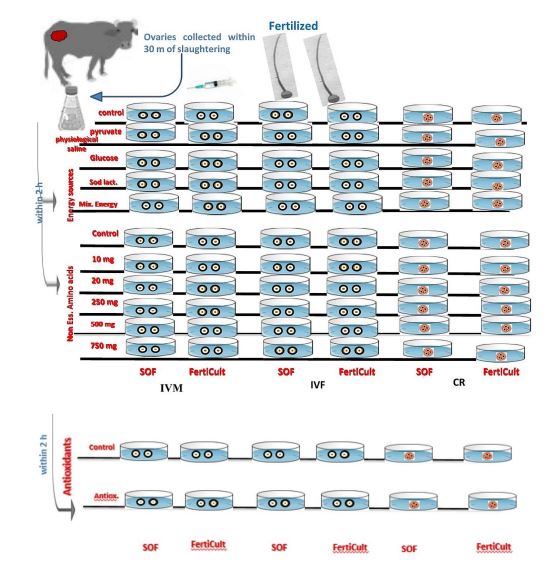
The study was designed to monitor the cleavage rate (CR) and in-vitro cultivation rate (IVC) after addition of energy sources, non-essential amino acids, and antioxidants to the Synthetic oviductal fluid (SOF) and FertiCult. After in-vitro maturation and in-vitro fertilization, presumptive zygotes were cultured in one of two culture media: FertiCult media and SOF medium, supplemented with pyruvate, glucose, and sodium lactate as energy sources, as well as 10, 20, 250, 500, and 750 mg non-essential amino acids, and antioxidants. All stages of cleavage rate (CR), and in-vitro cultivation rate (IVC) of embryonic development including morula stage (MOR) and blastocyst (BLAS) have been assessed. The findings revealed that there were no significant differences in the CR between the control and other treated groups with sources of energy when added to SOF media (P > 0.05), while there were significant differences (P < 0.05) in the IVC of embryonic development between groups (The percentages of MOR stage in the control, pyruvate, glucose and mixture of source of energy (MIX) were at 50%, 62.5%, 60%, and 63.6%, respectively). The highest percentage of the BLAS was recorded after SOF supplementation with glucose (40%). Similarly, there were no significant differences (P > 0.05) in the CR between control and FertiCult supplemented with sources of energy, while the IVC stages increased significantly (P < 0.05) in the FertiCult media supplemented with glucose, pyruvate, sodium lactate, and MIX. The percentages of the MOR stage in the control, pyruvate, glucose and mix media were at 50%, 55.6%, 55.6%, 54.5%, 57.1% respectively. The lowest percentage of the BLAS was recorded after FertiCult supplementation with pyruvate (11.1%). Replenishing the SOF maturation media with 20 mg of non-essential amino acids significantly (P < 0.05) enhanced the MOR stage (100%). There was also an improvement in the development of BLAS stage, where it reached 31.2% and 47.4% in the SOF maturation media supplemented with 10, and 750 mg non-essential amino acids, respectively. There were no significant differences (P > 0.05) in neither CR nor IVC between control and FertiCult supplemented with antioxidants. There were significant differences (P < 0.05) in the MOR stages (control, 42.9% & treated, 57.9%) and BLAS stages (control, 21.4% & treated, 42.1%) in antioxidant supplemented SOF maturation media compared to control. In conclusion, supplementation of SOF cultivation medium with energy sources, 20 mg of non-essential amino acids and antioxidant addition may improve the cleavage rate (CR) and in vitro cultivation rate (IVC) of buffalos’ embryonic development.
Research Authors
Eman M Abu El-Naga, Montaser E. Ali, Rawda H. Ali, Heba F. Hozyen & Hassan A. Hussein
 Do you have any questions?