IMPACTS OF PROBIOTICS WITH OR WITHOUT ORGANIC ACIDS AS DIETARY SUPPLEMENTS ON GROWTH PERFORMANCE, CARCASS QUALITY, DIGESTIBILITY, INTESTINAL DEVELOPMENT, AND GUT MICROBIOTA OF BROILER CHICKS
The access of vinasse leachates to water bodies and groundwater exacerbates environmental problems, especially eutrophication. Therefore, a column experiment was performed to examine the effect of adding zeolite (ZL), bone char (BC), and wood chips biochar (WCB) in the presence of vinasse on carbon dioxide (CO2) emission, leaching dissolved organic carbon (DOC) and ammonium (NH4+) in calcareous sandy soil, as well as studying the kinetics of leaching dissolved organic carbon and ammonium. This column experiment contains four treatments: soil alone (CK), soil + zeolite (SZL), soil + bone char (SBC), and soil + wood chips biochar (SWCB). These amendments were applied to the soil at a level of 4%. Vinasse was added to all treatments at a level of 13 mL per column. The leached total cumulative DOC and total cumulative soluble ammonium amounts decreased significantly with applying ZL, BC, and WCB compared with the soil alone. The effectiveness of these amendments in lowering the total cumulative DOC leaching is in the order of SBC > SWCB > SZL >CK. However, the effectiveness of these amendments in decreasing the total cumulative NH4+ leaching is in the order of SZL > SWCB > SBC >CK. The rate constant (k) of DOC leaching decreased significantly with the application of bone char compared to soil alone treatment. In the presence of vinasse, the apparent half‑life of leached DOC from the soil was 8.1, 12.9, 36.7, and 15.5 days for soil CK, SZL, SBC, and SWCB treatments, respectively. Half‑life values of leached soluble ammonium from the soil in the presence of vinasse addition were 10.1, 39.5, 28.5, and 37.9 days for CK, SZL, SBC, and SWCB treatments, respectively. Amending soil with BC increased significantly the phosphorus availability, however, applying ZL and BC caused a significant increase in the available potassium in calcareous sandy soil compared to the control treatment. According to these results, it is recommended not to add vinasse alone to sandy soils, but it is preferred to be co‑applied with BC amendment at the level of 4% better than ZL and WCB. This would decrease leaching DOC and ammonium to the water table and groundwater as well as enhance nutrient retention in the soil, which in turn, plays a vital role in reducing the harmful effect of vinasse and improving soil fertility.
Pollution by petroleum hydrocarbons (PHCs) is a current environmental challenge all over the world. Therefore, this study was established to evaluate the impact of calotropis procera biochar (CPB) produced at various pyrolysis temperatures on carbon emission, ammonia volatilization, degradation of PHCs, and properties of artificial petroleum-contaminated soil. An incubation experiment was performed with CPB produced at 400 °C (CPB400) and 650 °C (CPB650). The artificial petroleum-contaminated soil was amended with biochar at doses of 1, 2.5, and 5% along with the unamended soil (control) and incubated for 78 days. The results demonstrate that the CO2-C emission rate in petroleum-contaminated soil increases significantly with all biochar applications compared to the control treatment. Adding CPB400 into the soil, at all doses, decreased cumulative NH3 emission significantly, in comparison with control and CPB650 treatments during all incubation periods. Total PHCs concentration in the soil reduced significantly with CPB400 application at 2.5% compared to the control treatment. CPB400 was more effective in declining total PHCs content in the soil than biochar produced at 650 °C. Available phosphorus and potassium in petroleum-contaminated soil increased significantly under biochar applications compared with the control treatment. Using Calotropis procera biochar produced by low-temperature pyrolysis as an amendment can play a vital role in the remediation of PHCs in polluted soils, it is also a promising way to improve the quality indicators of petroleum-contaminated soil.
This study aims to knowledge the chemical composition of essential oils (EOs) extracted by hydro steam distillation of anise (Pimpinella Anisum) and fennel (Foeniculum vulgare) seeds which analyzed by gas chromatography-mass spectrometry (GC-MS). Whereas the main components of anise essential oil (AEO) were Transe Anethole (91.75%), γ-Himachalene (2.28%) and Carvone (1.71%). While the main constituents of fennel essential oil (FEO) were Estragole (74.46%), Transe Anethole (10.38%), D-limonene (10.06%) and Fenchone (3.04%). The antimicrobial activities of AEO and FEO (inhibition zone in mm) were evaluated, the results indicated that, AEO and FEO showed inhibition zones against Bacillus cereus (8 and 8 mm), Bacillus subtilis (10 and 10 mm), Staphylococcus aureus (13 and 13 mm), Escherichia coli (12 and 8 mm), Pseudomonas aeruginosa (8 and 9 mm) and Salmonella typhimurium (10 and 9 mm), Aspergillus flavus (24 and 18 mm), Aspergillus niger (13 and 17 mm), Cladosporium sphaerospermm (14 and 14 mm), Mucor racemosus (18 and 15 mm), Penicillium chrysogenum (22 and 33 mm), Rhizopus arrhizus (26 and 24 mm), Candida albicans (18 and 28 mm), Debaryomyces hansenii (12 and 10 mm) and Pichia membranifaciens (26 and 12 mm) for AEO and FEO; respectively. It was concluded from this study that the essential oils extracted from fennel and anise show antimicrobial activity against many harmful microorganisms.
This study was designed to evaluate the effect of adding the essential oils (EOs) extracted from marjoram, peppermint, anise and fennel compared with synthetic antioxidants (BHT and BHA) to sunflower oil (SFO) on the oxidative stability during heat treatments (180±5°C for 18 h). Results showed that the aromatic plants contained of phenolic substances (26.52 - 45.26 mg) can be used as natural antioxidants. Using of antioxidants (EOs and BHT, BHA) with SFO increased their oxidative stability compared with untreated SFO sample (control).Data demonstrated that the values of acid, peroxide, thiobarbituric acid (TBA value), conjugated diene and triene increased to the highest rates in SFO control (without antioxidant) compared to SFO + antioxidant, while the iodine value was significantly decreased in SFO control compared with SFO + antioxidant during heating. The data also showed that the thermal stability (Rancimat value) of SFO was enhanced by adding EOs. Generally the adding of EOs as natural antioxidants can definitely create a significant impact in the market as there is no adverse health effect on the usage of EOs as a natural compounds compare with synthetic antioxidant in food.
This study aimed to improve the color removal of talodora syrup by using sodium metabisulfite and ammonium persulphate, which have a very important effect in the bleaching process. The behavior of the materials used at different concentrations on Brix and the pH of the syrup was studied, as well as the color removal efficiency. Experiments were carried out at Hawamdia sugar refinery factory, Giza Governorate, in the General Administration for Quality and Control, during September and October 2022. The results showed that the rate of decolorization of the samples increased with the increase the concentration of the additives. The best color removal of the syrup is 60.4% when using Sodium metabisulfite at a concentration of 550 ppm on the processed syrup. While the best color removal of the syrup was 35.2% when ammonium persulphate at a concentration of 800 ppm was added to outlet syrup of talodora when compared to color of outlet syrup of talodora. On the other hand, it became clear that the removal color of the syrup when adding the material at the same concentration to the treated syrup was 70.2%, when compared to the color of the syrup inlet talodora. Through the results obtained, it was clear that ammonium persulfate was better than sodium meta sulfite of its effect on removing the color of syrup.
Two grapefruits juices from white and pink cultivars were studied to evaluate some physical properties, chemical, antioxidantive components, antioxidant activity, as well as, minerals and some vitamins.
Allergic diseases, derived from the dysregulation of immune tolerance mechanisms, have been
rising in the last two decades. Recently, increasing evidence has shown that probiotic-derived
polysaccharide capsules exhibit a protective effect against allergic diseases, involving regulation
of Th1/Th2 balance, induction of differentiation of T regulatory cells and activation of dendritic
cells (DCs). DCs have a central role in controlling the immune response through their interaction
with gut microbiota via their pattern recognition receptors, including Toll-like receptors and C-typelectin receptors. This review discusses the effects and critical mechanism of probiotic-derived
polysaccharide capsules in regulating the immune system to alleviate allergic diseases. We first
describe the development of immune response in allergic diseases and recent relevant findings.
Particular emphasis is placed on the effects of probiotic-derived polysaccharide capsules on allergic
immune response. Then, we discuss the underlying mechanism of the impact of probiotic-derived
polysaccharide capsules on DCs-mediated immune tolerance induction.
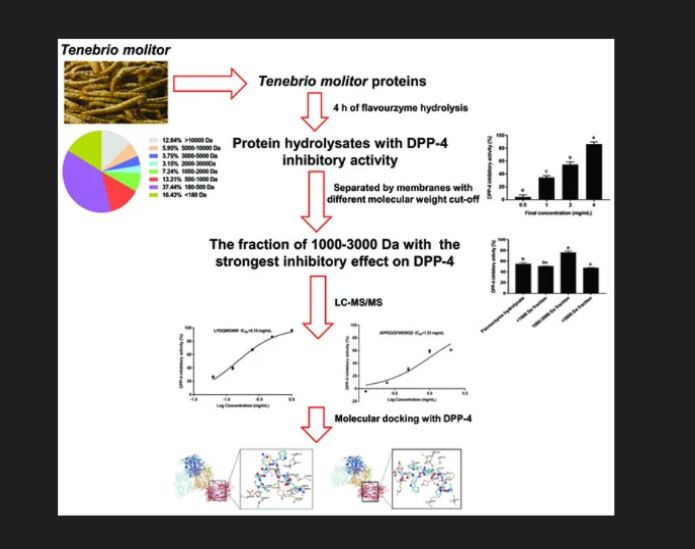
Inhibition of dipeptidyl peptidase-4 (DPP-4) is an effective way to control blood glucose in
diabetic patients. Tenebrio (T.) molitor is an edible insect containing abundant protein. T. molitor proteinderived peptides can suppress the DPP-4 activity. However, the amino acid sequence and binding
mechanism of these DPP-4 inhibitory peptides remain unclear. This study used the flavourzyme for
T. molitor protein hydrolysis, identified the released peptides with DPP-4 inhibitory effect, and investigated the binding interactions of these peptides with DPP-4. The results showed that flavourzyme
efficiently hydrolyzed the T. molitor protein, as demonstrated by the high degree of hydrolysis, disappearance of protein bands in SDS-PAGE, and changes to protein structure. The 4-h flavourzyme
hydrolysates showed a good inhibitory effect on DPP-4 (IC50 value of 1.64 mg/mL). The fragment of
1000–3000 Da accounted for 10.39% of the total peptides, but showed the strongest inhibitory effect on
DPP-4. The peptides LPDQWDWR and APPDGGFWEWGD were identified from this fraction, and
their IC50 values against DPP-4 were 0.15 and 1.03 mg/mL, respectively. Molecular docking showed
that these two peptides interacted with the DPP-4 active site via hydrogen bonding, hydrophobic
interactions, salt bridge formation, π-cation interactions, and π-π stacking. Our findings indicated
that T. molitor protein-derived peptides could be used as natural DPP-4 inhibitors.
The antifungal effect of metabolites produced by a new strain of Lactiplantibacillus (Lpb.)
plantarum LPP703, isolated from naturally fermented yak yogurt, was investigated. The results
showed that Lpb. plantarum LPP703 significantly inhibited four fungal species, including Penicillium
sp., Rhizopus delemar, Aspergillus flavus, and Aspergillus niger. The metabolites produced after 20 h
of Lpb. plantarum LPP703 fermentation showed the highest antifungal activity against Penicillium sp.
Compared with the control group, the Lpb. plantarum LPP703 metabolites-treated Penicillium sp.
spores were stained red by propidium iodide, indicating that the cell membrane of the fungal
spores was damaged. Moreover, the antifungal effect of the Lpb. plantarum LPP703 metabolites on
Penicillium sp. was not changed after heating or treatment with various proteases, but showed a sharp
decrease when the pH value was regulated to 5.0 or above. The oleamide, trans-cinnamic acid, and
citric acid were the three most abundant in the Lpb. plantarum LPP703 metabolites. Molecular docking
predicated that the oleamide interacted with the active site of lanosterol 14-alpha-demethylase (CYP51,
a crucial enzyme for fungal membrane integrity) through hydrogen bonds and had the lowest docking
score, representing the strongest binding affinity to CYP51. Taken together, the metabolites from a
new strain of Lpb. plantarum, LPP703, had potent antifungal activity against Penicillium sp., which
might be associated with the damage of the active ingredient to fungal membrane integrity. This
study indicated that Lpb. plantarum LPP703 and its metabolites might act as biological control agents
to prevent fungal growth in the food industry.