Development of an Accelerated Thermal Cycling Test Setup and Machine-Learning-Based Lifetime Prediction of IGBT Modules in Inverter Operation

Research Abstract

The reliability of Insulated Gate Bipolar Transistor (IGBT) modules is critical for long-term durability and operational stability in power electronic systems. This paper presents a real-time degradation-monitoring and lifetime-prediction framework for IGBT modules using accelerated power-cycling tests under realistic inverter conditions. A two-level SVPWM inverter is used, with electrically driven current loading and developed induction heating, along with an active water-cooling system, to create precise junction-temperature swings to investigate thermal fatigue. Continuous acquisition of on-state voltage and temperature data is performed throughout the aging of six IGBT modules under two junction-swing conditions. The degradation behavior is examined through experimentally observed trends and used to develop a machine-learning model based on Random Forest (RF) to predict the remaining useful lifetime (RUL) utilizing the extracted degradation indicators. A comparative analysis with a Support Vector Regression (SVR) and Gaussian Process Regression (GPR) models is performed to validate the RF model’s effectiveness, confirming that the RF model has greater accuracy, robustness, and computational efficiency with limited datasets. The proposed framework thus integrates experimental testing, and data-driven prediction, attaining lifetime-prediction errors under 4% while utilizing only 20–60% of the lifetime data, offering a precise and scalable method for assessing inverter-level IGBT reliability.

Research Authors
Ahmed H Okilly, Cheolgyu Kim, Seungdeog Choi, Jeihoon Baek
Research Date
Research Department
Research Journal
IEEE Journal of Emerging and Selected Topics in Power Electronics
Research Member
Research Publisher
IEEE
Research Rank
International Journal, Q1 WOS, Q1 Scopus, IF 5.7
Research Website
https://ieeexplore.ieee.org/abstract/document/11481045
Research Year
2026

Cyber-Physical Radiative EMI Attacks on Sensorless Motor Drives: Destabilization, Adaptive Torque Manipulation, and Physics-Based Detection

Research Abstract

Electromagnetic interference (EMI) is an emerging cyber–physical threat to sensorless motor drives that rely on accurate current feedback. This paper presents an experimental study of radiative EMI attacks on a three-phase GaN inverter operating under sensorless field-oriented control. Specifically, non-contact EMI intrusion is investigated to examine how it may disrupt current sensing and electrical angle estimation, resulting in torque degradation and eventual loss of synchronism. Beyond instability, an adaptive EMI attack is presented in which disturbance amplitude is adjusted using only an external rotor speed measurement and a simple mechanical torque estimator to steer the drive toward a malicious torque operating point without access to internal controller variables, demonstrating that EMI can function as a controllable analog attack channel rather than a random disturbance. Additionally, a physics-based detection technique is proposed that provides early, low-latency attack detection under the tested conditions by tracking torque consistency across the mechanical and electrical domains. Experimental results demonstrate the effectiveness of both the adaptive attack and the proposed detector.

Research Authors
Peter Harmony, Md Moniruzzaman, Ahmed H. Okilly, Jeihoon Baek, Seungdeog Choi
Research Date
Research Department
Research Journal
IEEE Journal of Emerging and Selected Topics in Power Electronics
Research Member
Research Publisher
IEEE
Research Rank
International Journal, Q1 WOS, Q1 Scopus, IF 5.7
Research Website
https://ieeexplore.ieee.org/document/11749530
Research Year
2026

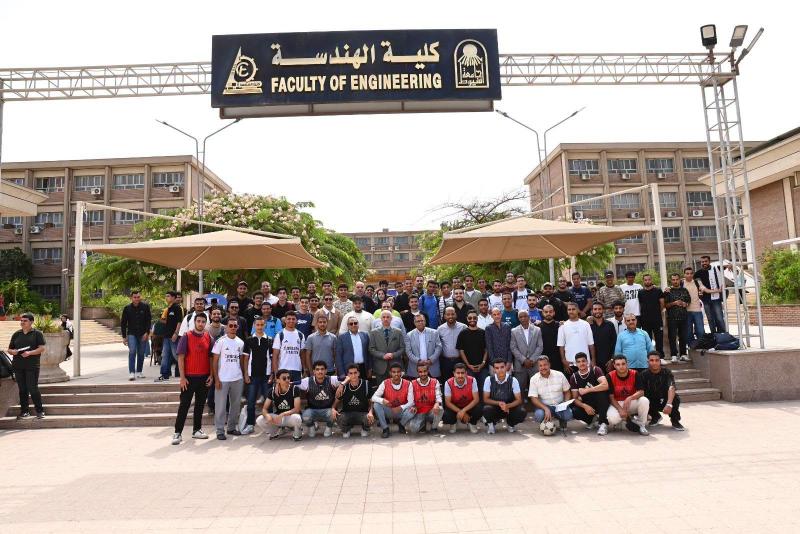
Assiut University President attends sports tournament events at the Faculty of Engineering

Assiut University President Attends Faculty of Engineering Sports Tournament and Commends Student Projects and Innovations

As reported by the Assiut University Media Office:

On Tuesday, October 6, Professor Ahmed Abdel-Mawla, President of Assiut University, visited the Faculty of Engineering to observe the ongoing sports tournament and student activities. The event featured various athletic competitions alongside an exhibition showcasing scientific projects and innovations. The visit was attended by Professor Khaled Salah, Dean of the Faculty of Engineering, and Professor Mohamed Safwat, Vice Dean for Education and Student Affairs.

The activities included a five-a-side football tournament for the faculty’s various departments, as well as table tennis and chess competitions for both male and female students. These events were organized under the supervision of Mohamed Sharaqa, Director of the Faculty’s Student Welfare Department, with the active involvement of activity coordinators.

The University President also toured a scientific exhibition presented by the "AZMI" team—a student group operating under the faculty’s Scientific Activities Department. The exhibition featured a range of projects and innovations across diverse engineering and technological fields, including an electric vehicle, several multi-purpose robots, and 3D printing devices. The team’s work was overseen by their academic supervisor, Dr. Mohamed Eid, a lecturer in the Department of Mechanical Engineering.

Dr. Ahmed Abdel-Mawla listened to the students as they explained their projects and innovations, learning about the mechanisms behind their development and their potential applications. He praised the ideas and projects presented, noting that they reflect the students' strong scientific capabilities and practical skills. He further emphasized the importance of providing students with opportunities to transform their academic knowledge into innovative, tangible projects. The President of Assiut University emphasized the university’s commitment to supporting student activities across all fields. He noted that such activities are a fundamental component in shaping a student’s character, as they foster a spirit of teamwork and healthy competition, help discover talents, refine academic and practical skills, and strengthen a sense of belonging and active participation.

Dr. Abdel-Mawla encouraged students to continue engaging in student activities and events, and to take full advantage of the resources and opportunities provided by the university to develop their capabilities and skills—aligning them with the demands of the labor market and the rapid advancements in scientific and technological fields.

For his part, Dr. Khaled Salah commended the Assiut University administration for its support of student activities within the Faculty of Engineering, as well as the attention given to student teams and scientific projects. He highlighted that these activities offer a vital opportunity for students to apply their academic studies in a practical setting, cultivate innovation and teamwork skills, and gain the experience necessary to compete effectively in the labor market and various professional sectors.

1
 
1
 
1
 
1
 
1
1
1
 
Subscribe to