 Do you have any questions?

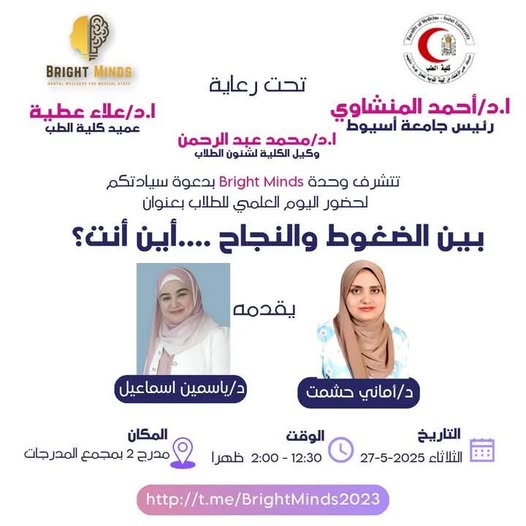
An invitation to attend the scientific day organized by the Bright Minds Unit for students, deputies, and interns from the Faculty of Medicine, entitled: "Between Stress and Success... Where Are You?"
Invitation to the Master's Thesis Discussion for Hind Mohamed Abdel Moez Issa, Resident Physician, Department of Neurology and Psychiatry, Faculty of Medicine, Assiut University.
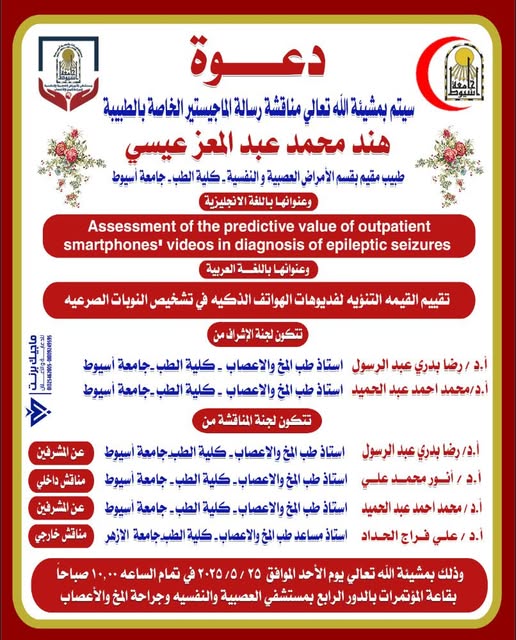
Invitation to the Master's Thesis Discussion for Hind Mohamed Abdel Moez Issa, Resident Physician, Department of Neurology and Psychiatry, Faculty of Medicine, Assiut University.
Congratulations to Professor Dr. Hanan Sayed Farghaly, Professor and Head of the Department of Pharmacology, on the occasion of joining the Egyptian Drug Authority.
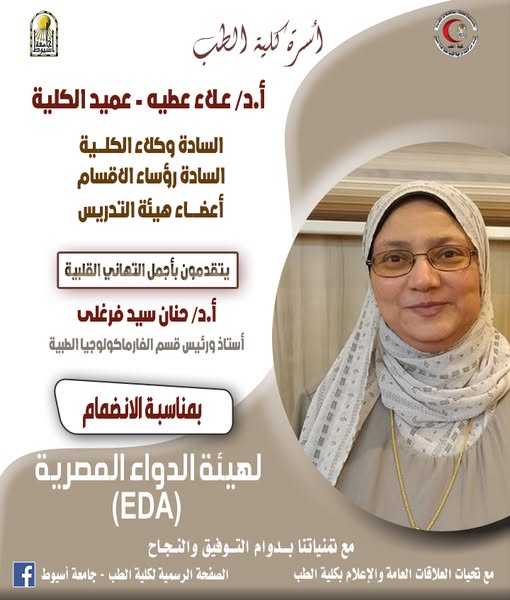
Congratulations to Professor Dr. Hanan Sayed Farghaly, Professor and Head of the Department of Pharmacology, on the occasion of joining the Egyptian Drug Authority.
Identifying Predictors of Early Postoperative Pain and Patient Satisfaction Following Day Surgery: Insights From an Observational Study
Research Date
Research Department
Research Journal
Cureus Journal of Medical Science
Research Member
Research Pages
1-16
Research Publisher
Published via NEMA Research Group. Springer Nature
Research Vol
17
Research Year
2025
Role of magnetic resonance imaging in characterization of superficial soft tissue masses
Research Date
Research Department
Research Journal
Egyptian Journal of Radiology and Nuclear Medicine 56 (1), 1-8
Research Member
Research Year
2025
Gallic acid counteracts tartrazine-induced testicular dysfunction in rats: biochemical, histopathological and ultrastructural evidences
Research Abstract
Background Tartrazine (Tz) is one of the most commonly used colorants incorporated in the food manufacturing. Its toxicity is derived from metabolic byproducts representing health hazards to consumers. Gallic acid (GA) is known for its redox stabilizing, anti-apoptotic, and cytoprotective characteristics. Therefore, the aim of this study is to explore the possible defensive efect of GA against Tz-induced testicular dysfunction. To achieve this objective, 18 male Wistar adult rats were randomly and equally categorized into three groups for 30 days. The control group received no treatment. Tz at a dose of 30 mg/kg BW was administered to the Tz group. The Tz+GA group received GA at a dose of 200 mg/kg BW in concurrent with the previously described Tz dosage. Both Tz and GA were supplemented orally once daily by a stomach tube. Results The marked decline in luteinizing hormone, follicle stimulating hormone, testosterone, and estradiol 17beta confrmed deviation in pituitary–gonadal axis of Tz-exposed rats. Imbalances in plasma redox equilibrium were evi‑ dent, characterized by a notable increase in malondialdehyde and nitric oxide levels, along with a decrease in reduced glutathione and total antioxidant capacity. Deteriorations in histopathological features, fbrosis in testicular tissue, abnormalities in Sertoli cell, and up-regulation in caspase-3 were observed. Conversely, GA administration successfully reversed these issues. Conclusion The ability of GA to counteract toxicological molecular targets in Tz-exposed testes is believed to be achieved through the restoration of oxidant/antioxidant balance and the prevention of the apoptotic cascade. Keywords Tartrazine, Gallic acid, Testis, Sexual hormones, Redox balance, Apoptosis
Research Date
Research Department
Research Journal
The Journal of Basic and Applied Zoology
Research Member
Research Year
2024
Testicular tissue oxidative stress in azoospermic patients: Effect of cryopreservation
Research Abstract
This study evaluated oxidative stress (OS) in human testicular tissue in obstructive (OA) and nonobstructive azoospermia (NOA) before and after cryopreservation. Azoospermic patients were subjected to surgical sperm retrieval (SSR) and cryopreservation. Assay of catalase activity (CAT) and malondialdehyde level (MDA) using colorimetric methods was done. The number of retrieved spermatozoa and the Johnson score were assessed in fresh testicular samples. The study included 21 OA (group A) and 16 positive sperm retrieval (group B, positive NOA). The basal CAT activity in the positive NOA group was significantly higher than that in the OA group. Basal MDA level was also significantly higher in NOA than in OA group. CAT activity and MDA level correlated negatively with the mean number of retrieved spermatozoa. After cryopreservation, there was a significant increase in CAT activity in OA, while there was no significant difference in MDA level in both OA and positive NOA. We concluded that patients with NOA seem to have increased testicular OS compared to OA. The extent of OS correlated negatively with spermatogenesis grade. Testicular tissue of patients with OA seems to withstand OS induced by cryopreservation more than NOA.
Research Date
Research Department
Research Journal
Andrologia
Research Member
Research Website
https://doi.org/10.1111/and.13817
Research Year
2020
Bachelor of Medicine and Surgery (MBBS) Five-Year System (Accredited Points Program) Special Program


Bachelor of Medicine and Surgery (MBBS) Five-Year System (Accredited Points Program) General Program

Bachelor of Medicine and Surgery (MBBS) Five-Year System (Accredited Points Program) General Program
